
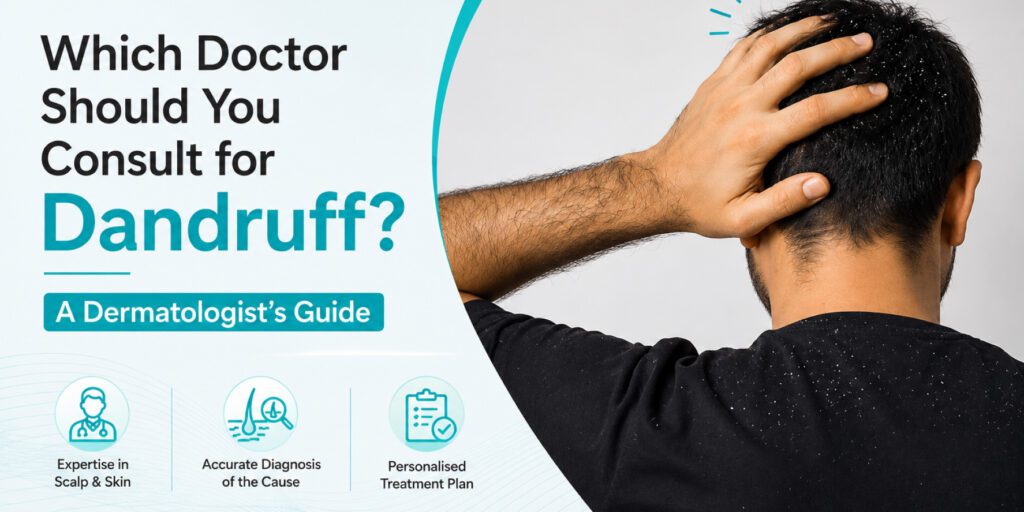
Dandruff is common and can often be managed with an appropriate anti-dandruff shampoo. However, persistent flakes, itching, redness, scalp irritation, or recurring symptoms may have another underlying cause. Conditions such as seborrheic dermatitis, psoriasis, eczema, contact dermatitis, or fungal infections can sometimes look similar to ordinary dandruff.
If you are wondering which doctor to consult for dandruff, a dermatologist is the appropriate specialist for persistent or difficult-to-control scalp problems. A dermatologist can examine your scalp, identify the likely cause and recommend treatment based on the diagnosis.
Which Doctor Should You Consult for Dandruff?
For persistent, severe, or recurring dandruff, you should consult a dermatologist.Dermatologists specialise in conditions affecting the skin, hair and scalp. They can determine whether your symptoms are actually dandruff or another scalp condition that requires different treatment.
This distinction matters because several conditions can cause similar symptoms, including:
- Seborrheic dermatitis
- Psoriasis
- Eczema Contact dermatitis
- Fungal scalp infections
- Other inflammatory scalp conditions
A dermatologist can assess the scalp and develop a treatment plan based on the underlying condition rather than treating the flakes alone.
Is Dandruff a Skin or Hair Problem?
Dandruff is primarily a scalp skin condition, even though its most visible sign is flakes in the hair.
Dandruff may cause:
- White or yellowish flakes
- Scalp itching
- Dryness or irritation
- Greasy or flaky areas
- Scalp redness in some people
Dandruff is not necessarily caused by poor hygiene. It can be associated with seborrheic dermatitis, oily skin, certain scalp conditions, and other factors.
Because the scalp is skin, a dermatologist is often the most appropriate specialist when dandruff becomes persistent or difficult to control.
When Can You Treat Dandruff Yourself?
Mild dandruff without significant redness, pain, swelling or other concerning symptoms can often initially be managed with an anti-dandruff shampoo.
Different shampoos contain different active ingredients and work in different ways. Depending on the product, ingredients may include ketoconazole, selenium sulfide, salicylic acid, zinc pyrithione, sulfur, or coal tar.
Follow the product instructions carefully, as some medicated shampoos need to remain on the scalp for a specific period before rinsing.
If your symptoms do not improve despite appropriate use, professional evaluation is recommended.
When Should You See a Dermatologist for Dandruff?
Consider seeing a dermatologist if:
- Dandruff persists despite using an appropriate anti-dandruff shampoo.
- Your scalp is very itchy.
- You have significant redness or swelling.
- Your scalp becomes painful or develops crusting.
- Flaking extends to your eyebrows, ears, face or other areas.
- You develop patches that look different from ordinary dandruff.
- You notice hair loss along with scalp symptoms.
- The condition repeatedly improves and then returns.
- You are unsure whether you have dandruff or another scalp condition.
Persistent or severe symptoms may indicate an underlying skin condition that needs a different treatment approach.
What Conditions Can Look Like Dandruff?
Not every flaky scalp is ordinary dandruff.
Seborrheic Dermatitis
Seborrheic dermatitis is a common inflammatory skin condition that frequently affects the scalp. It can cause scaling, itching and areas of irritated or greasy skin. It can also affect areas such as the eyebrows, ears, nose and beard.
Psoriasis
Scalp psoriasis can cause thicker, well-defined patches with scaling. It may require a different treatment approach from ordinary dandruff.
Eczema
Eczema can cause a dry, itchy and irritated scalp and may sometimes be confused with dandruff.
Contact Dermatitis
Hair dyes, shampoos, styling products and other substances can irritate the scalp or cause an allergic reaction, leading to itching and flaking.
Fungal Scalp Infection
Some fungal infections can cause scaling and inflammation and may sometimes be associated with patchy hair loss. These conditions require appropriate medical diagnosis and treatment.
How Does a Dermatologist Diagnose Dandruff?
A dermatologist usually begins by asking about your symptoms, medical history, hair-care routine and how long the problem has been present.
The scalp is then examined for features such as:
- Type and distribution of scaling
- Redness or inflammation
- Greasy or dry patches
- Plaques or other skin changes
- Signs of infection
- Areas of hair loss
In many cases, examination of the scalp is enough to identify seborrheic dermatitis or another common condition. If the diagnosis is unclear, additional investigation may sometimes be required.
How Is Persistent Dandruff Treated?
Treatment depends on the underlying diagnosis.
For uncomplicated dandruff or seborrheic dermatitis, a dermatologist may recommend a medicated shampoo containing an appropriate active ingredient.
Depending on the severity and location of the condition, treatment may also involve topical medications or other approaches. Dermatologists may adjust treatment according to the severity of inflammation, the areas affected and how the scalp responds.
The goal is not simply to remove visible flakes. Treatment aims to control the underlying scalp condition, reduce symptoms and help prevent recurrent flare-ups.
Can Dandruff Cause Hair Loss?
Dandruff itself does not necessarily cause permanent hair loss.
However, persistent scalp inflammation, severe itching and repeated scratching can affect scalp health and may contribute to temporary hair shedding or breakage.
More importantly, some conditions that look like dandruff can themselves be associated with hair loss. For example, certain scalp infections may cause scaling together with patchy hair loss.
If you notice significant or sudden hair loss along with dandruff or scalp inflammation, it is worth having your scalp assessed by a dermatologist.
When Should You Seek Medical Attention?
Seek professional evaluation if your scalp symptoms are:
- Persistent
- Severe
- Painful
- Associated with swelling
- Associated with significant redness
- Accompanied by crusting or discharge
- Associated with patchy hair loss
- Spreading beyond the scalp
- Not improving with appropriate dandruff treatment
These features can indicate that something other than simple dandruff may be responsible.