
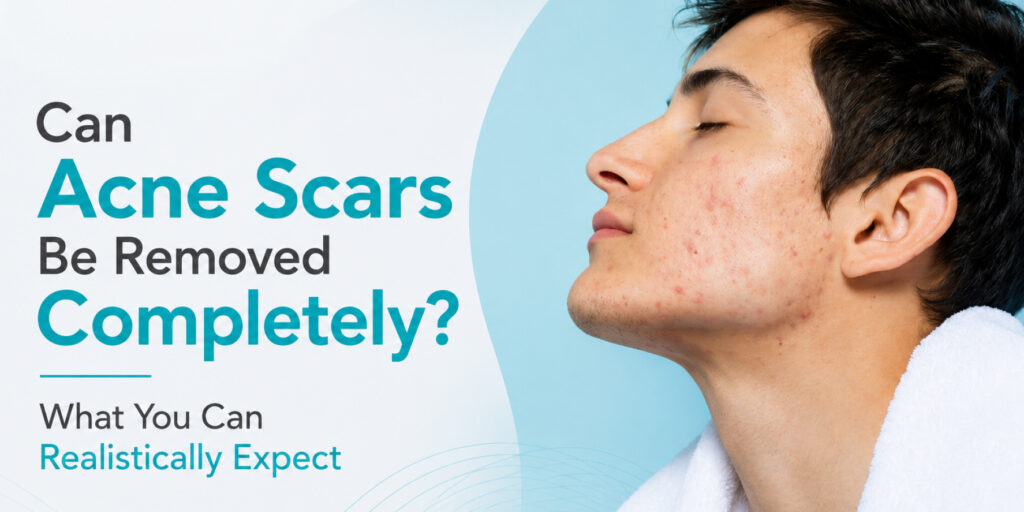
Acne scars can remain long after active acne has cleared, and it is natural to wonder whether they can be removed completely. The answer depends on the type, depth, age and extent of the scarring, as well as how your skin responds to treatment.
Some acne scars can become significantly less noticeable with appropriate treatment, but complete removal cannot be guaranteed. The goal of treatment is usually to improve the texture, depth, colour and overall appearance of scars rather than promise perfectly scar-free skin.
Understanding what is realistically achievable can help you choose treatment with appropriate expectations.
Can Acne Scars Be Removed Completely?
In most cases, acne scar treatment aims for significant improvement rather than guaranteed complete removal.
Acne scars can involve changes in the deeper structure of the skin. Once the skin has healed with permanent textural changes, treatment focuses on remodelling the scar tissue and improving the surrounding skin.
The degree of improvement varies between individuals. Some scars may become much less visible, while deeper or more extensive scars may continue to be noticeable even after treatment.
A dermatologist can assess your scars and explain what level of improvement may be realistic for your particular skin.
Why Are Some Acne Scars Difficult to Remove?
Acne scars are not simply marks sitting on the surface of the skin. Some involve changes in the deeper layers and supporting structures of the skin.
Factors that can make scars more challenging to improve include:
- Greater scar depth
- Long-standing scars
- Extensive scarring
- Multiple types of scars occurring together
- Ongoing active acne
- Individual healing response
- Skin pigmentation and tendency to develop post-inflammatory pigmentation
This is why there is no single treatment or number of sessions that guarantees complete scar removal.
Does the Type of Acne Scar Affect the Result?
Yes. Different acne scars have different structures, so treatment needs to be selected according to the scar type.
Ice Pick Scars
These are narrow, deep scars that extend into the skin. Because of their depth and structure, they can be more difficult to improve completely.
Boxcar Scars
These scars have broader depressions with more defined edges. Their appearance can vary considerably depending on their depth.
Rolling Scars
Rolling scars create an uneven or wave-like skin surface. They are often associated with changes beneath the surface of the skin.
Post-Acne Pigmentation
Dark or brown marks left after acne are not the same as depressed acne scars. They involve pigmentation rather than a permanent indentation in the skin and therefore require a different approach.
Identifying the difference between pigmentation and true acne scarring is important before selecting treatment.
Can Early Acne Scars Be Treated More Easily?
Early assessment can be helpful because active acne can continue to create new scars.
If new acne lesions are still developing, controlling the active acne is an important part of preventing additional scarring while existing scars are being addressed.
However, the age of a scar alone does not determine whether it can be treated. Scar type, depth, skin condition and individual response are also important.
Why Do Acne Scar Treatments Require Multiple Sessions?
Acne scar improvement usually develops gradually because the skin needs time to respond to treatment and remodel scar tissue.
Depending on the type and severity of scarring, a dermatologist may recommend a series of treatments rather than attempting to achieve maximum correction in one session.
The treatment plan may also change as the skin responds. Your dermatologist can assess the progress between sessions and determine whether additional treatment is appropriate.
Can Acne Scars Come Back After Treatment?
True structural acne scars do not usually "come back" in the same way that active acne can recur.
However, the appearance of the skin can change over time, and new acne can create additional scars.
Pigmentation associated with acne can also return or become darker when the skin is exposed to factors such as sunlight or inflammation.
This is why controlling active acne and protecting the skin remain important even after scar treatment.
What Can Make Acne Scars Look Worse?
Several factors can make existing scars or post-acne marks more noticeable.
New Acne Breakouts
Repeated inflammation can lead to additional scarring and pigmentation.
Picking or Squeezing Pimples
Manipulating acne lesions can increase inflammation and the risk of persistent marks or scars.
Sun Exposure
UV exposure can make post-acne pigmentation more noticeable and contribute to uneven skin tone.
Skin Irritation
Aggressive exfoliation or unsuitable skincare products can irritate the skin and potentially worsen post-inflammatory pigmentation.
Incorrect Treatment
Using treatments without identifying the type of scar can result in limited improvement or unwanted skin reactions.
How Is Acne Scar Improvement Assessed?
Acne scar improvement should be assessed over time rather than immediately after a procedure.
A dermatologist may consider:
- Scar depth
- Scar type
- Skin texture
- Overall skin tone
- Appearance under different lighting
- Changes compared with the starting point
- Development of new acne or pigmentation
Photographs taken under consistent conditions can also help document changes over the course of treatment.
The goal is to evaluate meaningful improvement, rather than promise complete removal.
When Should You See a Dermatologist?
Consider seeing a dermatologist if:
- Acne has left persistent depressions or uneven texture.
- You are unsure whether you have acne scars or pigmentation.
- Over-the-counter products have not improved the appearance of your scars.
- You have different types of scars on the same area.
- Active acne continues to cause new marks or scars.
- You are considering laser or other procedures for acne scars.
A dermatologist can identify the type of scarring and determine which treatment options are appropriate for your skin.